









Art & Design

Education

Overcoming Adversity

Personal

Tech & Metablogging

House & Home

Entertainment

Health & Fitness

Business

Politics

Military

Race & Ethnicity

Family

Green Living

Personal Finance

Religion & Philosophy

Travel & Expats

Sports

Fiction & Poetry

Food

Birth & Adoption

Crafts

Ice Cream in a Can, Teaching Science

Educationb{Originally published on SusieJ}

This summer, our hill at the lake will be used in yet another ingenious way: to make ice cream for our root beer floats. I was tempted to buy the traditional ice cream maker, but there are so many choices; I quickly became overwhelmed looking at all the bells and whistles. And besides, I have all that boy power just dying to get put to use. Plus, the process of making ice cream by hand… literally…. in the can… is is a great way to introduce some lessons in science. There is the ice cream in a bag method; my boys would surely break the bag in the mixing process. So, I’ve decided to go with the ice cream in a can method.

  1. The first challenge is finding the can. Many recipes suggest using
    a coffee can, but who buys coffee in a can anymore? A better idea is
    to ask for an empty paint can from the paint store. You’ll need two: A
    quart, and a gallon.
  2. Ask your kids to tell you the freezing point of water — or teach
    them — 32 degrees F, or 0 Celcius. Then, ask them what happens when we
    put salt on icy sidewalks. Ask them to start thinking about why we need
    salt to make ice cream.
  3. In the small, clean can, add one cup of milk or half and half, one cup of sugar, and one teaspoon of vanilla.
  4. Optional: add one tablespoon of chocolate syrup — or frozen strawberries.
  5. Use a hammer to seal the lid tightly.
  6. In the larger can, combine the ice and rock salt. Use a thermometer to record the temperature of the rock and salt mixture.
  7. Use hammer again to seal the lid tightly.
  8. Take turns rolling the can down the hill, for about five minutes. This will “solidify” the ice cream.
  9. Explain what’s happening: the ice melts and combines with the salt.
    This “brine” has a lower freezing point — lower than 32 degrees.
  10. After five minutes of rolling, open the large can, and take the
    temperature of the ice. It will be colder than it was the first time.
  11. Open the smaller can. The colder brine was able to get the milk
    mixture cold enough to freeze the milk mixture to make it solid, to
    create ice cream.
  12. You know you’re going to have to whip up another batch right now; the fun was really rolling the can down the hill.

Crazy About Quilting

Art design

Originally posted at Allsorts

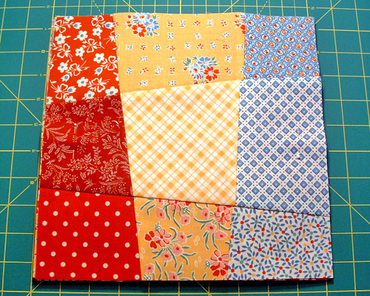
Finally! After years of thinking about trying my hand at making a quilt, I have completed all of the blocks for my very first one! I took a class last week with my Bernina sewing posse, and learned how to make a “crazy nine patch.” It is incredibly easy to make these blocks! I snapped pics along the way so you can try it, too.

First, here is one of the finished blocks:
Block1

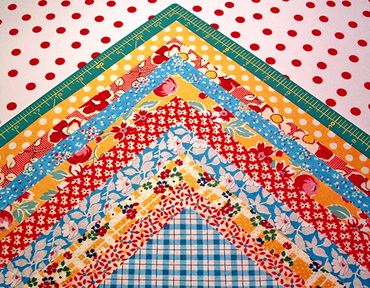
This quilt uses 36 fat quarters. I chose 12 each of red yellow and blue 1930’s inspired fabric.

Once you’ve chosen your fabrics, wash or rinse, dry them, then give a liberal spraying of starch and iron them so they’re nice and stiff.

Using a rotary cutter, cut them into 36 squares. Mine are 12″ but you can go bigger if you like. Divide into four stacks of 9 squares with the colors arranged red yellow blue red yellow blue, etc. But vary the order and which color is first in each stack, to assure a random scattering of color across your quilt.

Fabrics

(click title for more)


We’ll Take that to Go!

Blog Nosh Magazine Education

Originally Published on Blue Yonder

You know, I really try very hard to keep our lives simple.

I
think long and hard before I sign us up for something new, because
things just pile up so quickly, and I really don’t want my kids’
childhoods wasted away in an over-scheduled, hurry up and wait blur. I
want them to have the time to explore, to linger, to lay in the grass
and watch ants go about their busy lives - time to breathe. I want them
to take full advantage of this one time, this short time, in their
lives when they get to just be.
But, try as I might, there are times when there are complications and jam packed days that just can’t be avoided.
Now and again we have to visit the doctor’s office, or
wait for the car to be inspected, busy ourselves between lifeguard
breaks or wait for a brother to finish his music lesson.
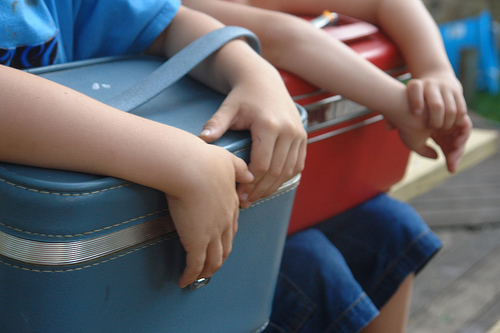
That’s how the “Go Boxes” came to be.

Go Boxes

(click title for more)